Wednesday, May 25, 2011

Making Mushrooms and Tempeh

Now for a post with some pictures! Back in March, Jim and I attended the Organic Growers School. This annual event in Asheville offers a mind-boggling array of classes on topics related to organic gardening, farming, and sustainable living.  Over the years, we've learned about rotational grazing, myco-remediation, growing berries, heirloom apples, raising chickens, making goat cheese, using draft horses, building with stacked stones, and so much more. There are always more classes of interest than we have time to attend. This year, we decided to go for quality over quantity and attend a couple of hands-on workshops instead of the shorter classroom sessions. Jim chose one on making tempeh while I went off to learn how to cultivate oyster mushrooms. We both came home with great goodies.

In addition to getting to snack on tempeh during his session with the lovely folks from Smiling Hara Tempeh, he brought home some tempeh of his own making. Well, I should say, in process of being made. I can't do justice to the steps involved since I was elsewhere at the time but I think I understand the procedure in gross terms. They started the process in the classroom by preparing the soybeans (the traditional but far from only legume that can be used), cooking the beans, inoculating them with the starter culture, and putting the mixture into a mold (in this case, a ziplock bag).


Then, he brought it home and had to keep it at a constant temperature--warmer than room temperature but not too warm--so we popped it in the food dehydrator at the lowest setting.


It was supposed to go for 24-48 hours but fortunately, the mycelium spread quickly so when the dehydrator timer turned off early, it didn't screw up everything. We had a lovely brick of tempeh that looks just like the stuff we buy from our local tempeh producers, Smiling Hara and Viable Cultures.


That may not look too appetizing, if you're not already a tempeh fan, but as one who has not yet been won over (thanks to not being short on protein options unlike Jim), I must confess that it was quite tasty when he cooked it up.  As with so many things, freshness makes all the difference.


If he ever gets to spend a bit more time at home, I think we'll see him experimenting with making tempeh from black beans and other legumes.

I, too, got to play with mycelium--the white stuff you see all over the tempeh at the end of the process and what is underlying most of the mushrooms you see. Mushrooms are to mycelium as apples are to the tree--they're just the fruit that the organism puts out to spread its seeds/spores.

In my workshop, we learned how to prepare a happy environment for oyster mushroom spawn (small amounts of mycelium). There are many ways to do this but for convenience, we used a method where you sterilize a bunch of straw and when it's cooled a bit, mix in the spawn. That mixture is then packed into a plastic bag and you add some air holes so the mycelium can breathe.


Like Jim's tempeh, my oyster mushroom spawn needed a nice, warm but not too warm place to hang out. Since it needed to be in the dark and be undisturbed for a few weeks, we chose a little-used closet. The idea was that as soon as I started seeing pins--the tiny beginnings of mushrooms--I needed to move it into the light. Oysters love light once the mycelium has had a chance to grow by chowing down on some of the straw. Sadly, we kept having cold snaps and the mushrooms just didn't want to come out and play. Until we went on vacation. Sure enough, the pins emerged while we were away. By the time we got back, only a few hardy shrooms developed in the dark room despite many, many pins.

I hung the bag on the shower rod near a window in the guest bathroom and misted the bag each day as instructed in hopes that it might fruit again. A couple of weeks and much warm weather later, new pins emerged.


Within days, many more came out and this time, we got gorgeous mushrooms.


Having missed the last fruiting, we made the most of this one. I dug out a recipe I'd been saving for the occasion: Asparagus and Oyster Mushroom Gratins with Spinach Chiffonade (recipe can be found at Vegetarian Times).


We're hoping that we get at least one more fruiting before the contents of the plastic bag become compost but it's starting to heat up like August this week and that may be too much for our mycelium. Fortunately, I'm getting good at finding oyster mushrooms in the wild. While they're not as elegant-looking at the cultivated ones, they have the distinct advantage of being large. More on my foraging adventures in another post. Some day. Who knows when? Not I.

Tuesday, May 24, 2011

A Little Bee Told Me

With so much going on lately, I've been remiss in keeping you up on how the bees are doing.  A story on NPR this morning on Why Honeybees Are Better Politicians than Humans reminded me. Do listen to/read the story if you haven't already. It features an interview with Thomas Seeley, author of the very intriguing book, Honeybee Democracy.

The good news is that my one hive from last year survived the winter. I didn't have high hopes for it given that we had another really bad winter with many lengthy cold snaps of single-digit weather. Still, I had deliberately avoided taking any honey from the hive last year to make sure that they would have plenty to get through the winter. They didn't have a lot anyway late in the summer but a spectacular abundance of late-blooming aster in the autumn allowed them to collect a crazy amount of nectar for that time of year (aster is great for bees but doesn't make nice honey for people, in case you're wondering why you don't see that alongside the clover, wildflower, and orange-blossom honey in the store).

Lots of honey and pollen (the carbs and protein, respectively, of the bee diet) are no guarantee of winter success as the previous year showed. Two of the three hives that year starved despite having food. They were so cold, the bees couldn't move from their cluster to get to the food and those that tried, died, leaving even fewer bees to keep the cluster warm. Eventually, the cluster got too small and froze in place. So depressing to find a frozen cluster in the spring with ample honey nearby. So, this past winter, I put lots of straw bales around my hive to serve as a windbreak and offer the bees a bit of assistance in staying warm.

I had my first indication that it was working on one unusually warm December day. I thought it was just in the 40s but I looked up from my computer and saw one of my honeybees at the window. That's a sure sign that the temperature is above 50 degrees. I raced outside and discovered that not only was it too lovely a day to stay inside but at least some of the bees were still alive. Several of them came to check me out as I went on my rounds that day. It's not unusual for them to come find me during the winter if I'm outside and it's warm enough for them to be out. I usually assume they're looking for food. I put out a little sugar water for them and watched a few of the bees check it out but at the end of the day it was mostly still there. I took that as a sign that they had plenty of honey in the hive and didn't need my charity. Still lots of winter to get through at that point but get through it they did.

By the time late winter warmed up enough to check up on the hive, it was clear that they had survived. It wasn't the strongest colony but they still had enough honey left and the foragers were finding pollen long before I could see anything blooming.

I have since added one new colony (I bought a nuc from a local apiary), so I have a bit more flexibility. If one colony is weak, I can combine it with the other into one hive. It's also easier to gauge the health of a colony when I have another for comparison. The tulip poplar trees have just finished blooming and so the biggest nectar flow of the year has come to an end. I hope to be able to peek into both hives later this week and see how much the girls were able to sock away.

Monday, May 16, 2011

Building a Stanchion

Wow! Remind me never to blog about blogging. It must be some kind of jinx. I go and blab about how I've managed to blog regularly for nearly a year and then nothing for a month. In my defense, it is a really busy time of year. The prosecution, however, would like to point out that there have been enough rainy days in the past month to counter any claims that springtime farm projects have taken all of my time. Yeah, but most of the rain came with intense thunderstorms and I unplugged during those surge-inducing events. Oh, all right. I confess. I just didn't get around to it.

With the next few posts, I'll try to catch you up on what's been going on around here. Our big project right now is trying to build a stanchion. We need something that can help restrain the water buffalo while we do veterinary work on them. They are due for shots and toe trimming and one of these days, the girls might just need a pregnancy check. The latter involves a plastic glove that goes up to the vet's shoulder. Got the picture? While the buffs might be chill with any or all of the procedures, we don't want to take a chance the first time out. Plus, having a place where I can keep a buffalo in one place without her wandering off should come in handy when it's milking time.

A larger cattle or buffalo operation would probably have a squeeze chute for restraint but that's way too expensive and unwieldy for our little farmstead. So, we decided to build a milking stall with a headgate using a modified version of something we saw on the Keeping a Family Cow website. Jim worked up plans sized to fit our growing buffs and taking into consideration their agility and craftiness.


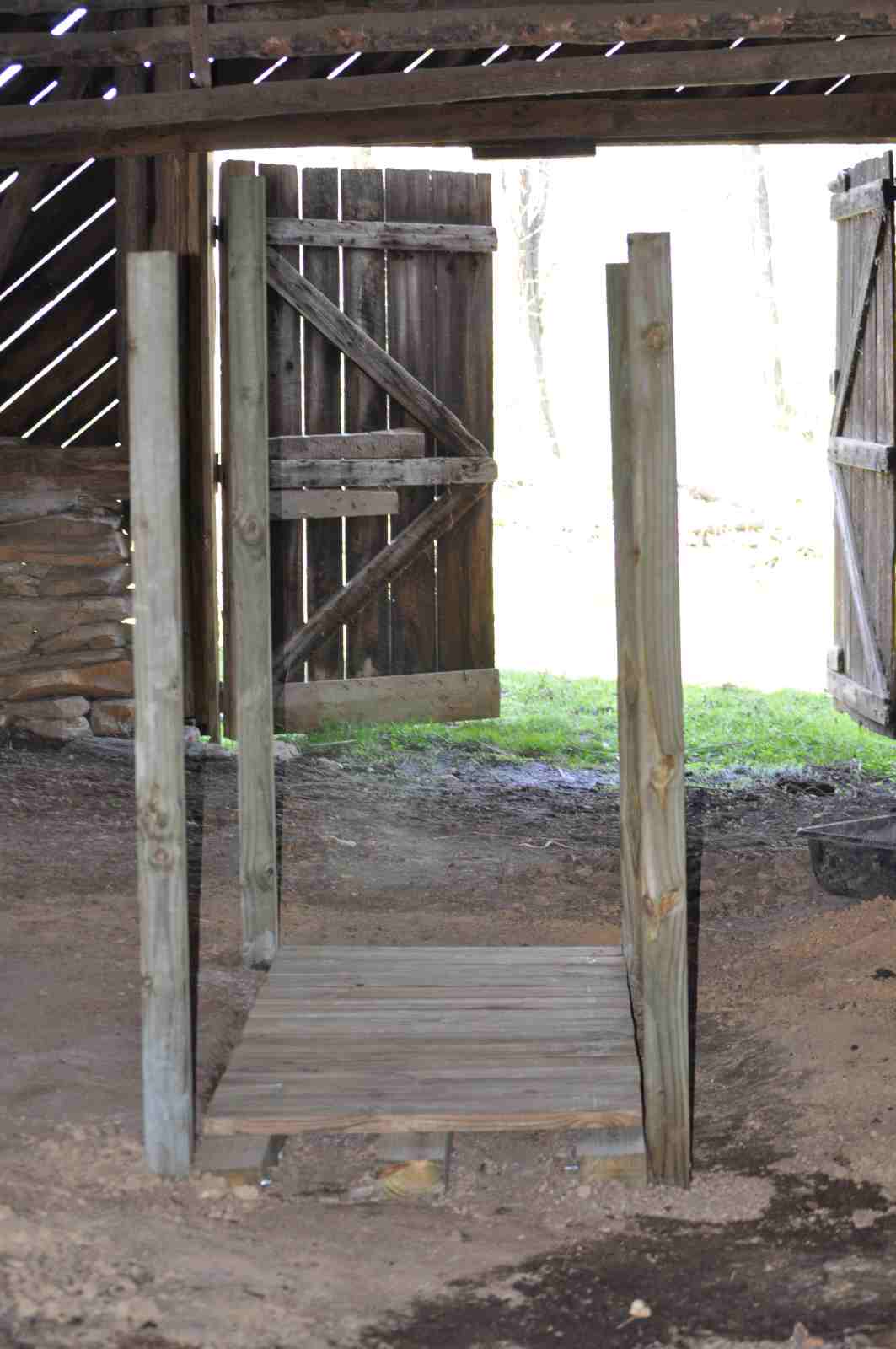
Behind the girls in the photo above is the lower barn. That's where we're building the stanchion. It is nicely set up for a straight shot from the main pasture on one side to the fish pond on the other. We sunk posts in concrete in the middle of the dirt floor and built a low deck supported by three 4x6s.


Next, we added some side rails:


In the photo above, you may see a bunch of corral panels leaning up against the wall. Those will form the corridor running between the doors and the stanchion.


Since I last took photos, we have erected the corridor, built (but not yet attached) the headgate, and introduced the buffs to the setup. Fortunately, the buffs showed no fear or hesitation about going through. Unfortunately, the buffs immediately zeroed in on all of the weaknesses. Eschol immediately put his horns to use, lifting the corral panels off of their hinges and Effie discovered that she could duck under the side rails. So, the to-do list got longer.

We were hoping to avoid putting lower rails on as they will get in the way of milking and trimming toes but I think I've figured out a way to install 2x4s that can be slid out of the way after the buff is restrained in the headgate. We've also installed pivoting blocks that keep the corral panels from being lifted by the buffs but can be turned for easy access when we need to move a panel aside. We are using strap and pin hinges for the swinging headgate. The pins are in and we just need to attach the straps to the headgate, then we should be ready to hang it and give the buffs another shot at testing our work.

The last step, I hope, will be to check the fit of the headgate on each buff to determine where the locking mechanism needs to be installed to ensure a snug but not uncomfortable fit. Sounds straightforward enough, but if you don't see any more posts from me, you'll know it has all gone horribly wrong.

Friday, April 22, 2011

Bon Appetit

It's been nearly a year since I started this blog. Admittedly, it hasn't turned out exactly as one might expect from the description beneath the title. Originally, I envisioned more discussion of the trials and rewards of trying to enjoy food when there's one strict vegetarian and one meat-loving omnivore in the family. There were even supposed to be some restaurant reviews but that hasn't happened.

With the arrival of the water buffalo, the blog quickly became a handy way to keep friends and family up to date on what's going on around the farm and in our kitchen. Since I never had any interest in trying to make a living at blogging, I've resisted the urge to try to monetize the site or pump up traffic. Still, I love looking at the stats and seeing how folks find the blog. That effort has revealed some of the unsavory side of blogging (e.g., traffic manipulation) but also some of the fun (e.g., getting to know people from other blogs).

One source of traffic to my blog surprised me: Bon Appetit. I subscribe to the paper edition of the magazine but wasn't sure why my blog kept getting hits routed from their website, so I followed the trail back and discovered this. Apparently, my version of their mushroom and lentil pot pie recipe got picked up in a column they run called "What People Are Cooking." Their people pick a recipe which had been featured in the magazine and then look around to see which blogs have featured the dish. A few of the best examples are featured in the column. It all feels vaguely incestuous but still I was flattered by the attention.

I may yet get around to talking about some of our favorite restaurants in Asheville and places we find when we're on the road but I think I'll leave the formal reviews to the pros. I really like enjoying my food when I'm eating it. If I had to remember the details accurately some hours or days later, I would have to take notes during my meal and that would just ruin it. As with a good book or movie, analyzing it--even after the fact--often takes something away from the emotional experience of it for me. Instead, I think I'll just put up some posts about our favorite places and why we love them. That is, unless I get distracted by some cute buffalo.....


Saturday, April 16, 2011

Spring Ephemerals and Black Condoms

Time to catch up on posts that should have gone up before vacation. I was hunting for early mushrooms and, while I didn't find the morels I sought, I found some lovely flowers. The spring ephemerals are here and gone in the blink of an eye so it's always exciting to find them just as they're coming up. I think my favorite one has to be the trout lily.


I know I've identified this flower before but the name is escaping me at the moment, so we'll just call it pretty white flower.


Although I came across several common shelf fungi on tree branches, I didn't find anything coming up out of the ground.


I came back with an empty basket but resolved to make frequent forays over the next month to check out my favorite mushroom spots. The appearance of the ephemerals often coincides with morel season, so if the nighttime temps are warm enough and there's a decent amount of rain, the conditions would be conducive for morels. 

Back to more mundane chores, the next morning I was shoveling manure and straw out of the barn and onto our tower of poop when I stopped short of unleashing the first round of doots. I did a very cartoon-y double take as my brain tried desperately to process what appeared to be a bunch of small black condoms on the manure pile. A closer look revealed that they were some sort of mushroom. They just happened to look very much like little black condoms on a white stem (think something akin to a mung bean sprout). I came back a couple hours later to take some pictures but they were already gone. Talk about ephemerals.

The next day, I looked for them in the same spot and sure enough, there they were. Only this time, I was a little earlier and saw that they look quite different when they first come up--more of a grey parasol that hasn't opened fully. I took some back to the house immediately to grab some photos, lamenting the fact that this day's specimens weren't nearly as large, so they didn't look quite so condom-like. 


As the parasol opens, the cap flattens out and the edges curl up, creating the rolled up edge that caught my eye initially.


These little guys flopped over before I could get the picture (insert your own joke here).


I searched my mushroom field guides but couldn't find a match (I think because I was looking for them as they appear in the late stages of decay). My friend Jason had just given me an old Time-Life style book on mushrooms which he'd found in a thrift store. Although it didn't have a wide variety of mushrooms, it did have great pictures--including one very similar to what I had found. That helped me narrow it down. I still don't know the exact variety but these fungi seem to be part of a group of mushrooms known as inky caps. If you touch the cap, you'll know why. The caps dissolve completely into an ink-like liquid. It stains your skin and, from what I've read, does work as a good substitute for ink. If you're ever in need of ink and happen to be near these 'shrooms, have at it. And if these are the kind I think they are, don't eat them! Not that they look very appetizing anyway, but they are toxic. Some variety of inky caps have an interesting toxin which mimics Antabuse. If you consume alcohol within a few days of ingesting the mushroom, you will experience a host of unpleasant effects (vomiting, tachycardia, sweating, headache, etc.) similar to what would occur if you were taking the drug Antabuse. I don't recommend inky caps as a way to kick the alcohol habit. Or as a prophylactic for that matter.


OK, now I'm going to post this, sit back, and wait to see what kind of interesting traffic comes to this blog as people search for "black condoms."

Thursday, April 14, 2011

Missed One

Had to leave you with one last photo from Kaua'i. This sign was on the door of an appliance store in Kapa'a:

Monday, April 11, 2011

Garden Isle--Part Deux

Negligent am I. Just because we have bananas nearly every day at home doesn't mean it's ok to skip them when talking about our wonderful fruit selection at the cottage on Kaua'i. And these little gems (tucked away on the far left side of the plate) are the lovely, if somewhat incongruously named, apple bananas. Small but sweet, they are the perfect size for snacking and they always make us think of lazy days on the Amazon.


Now, let's get out of the cottage. There were many sights to see just on the short drive from town to the cottage. Our daily drive(s) gave us a glimpse of Opaeka'a Falls:


And the Wailua River, Hawaii's only navigable river:


Nice commute. Practically in our backyard was the start of the trail to hike up Nounou Mountain a.k.a., the Sleeping Giant. Before beginning the 1000-foot ascent to the chin of the giant, we had to find the shortcut to the trail through a fence behind a shipping container (no secret handshake required).


Then there was a brief, cool walk through a stand of Norfolk pine trees before the steep, sweaty climb.


The reward for our efforts was a nice place to sit and enjoy the view out to the ocean.


If it weren't for his big head (the Giant's), we could have had 360-degree views. No matter. What we had was lovely.


There were a couple of picnic tables for those who were inclined to linger but on this day, as was the case every day, we needed coffee. In fact, this was the only day we did anything remotely energetic before seeking  out our coffee home away from home: Small Town Coffee.


A big part of the reason that we chose to stay in the Wailua-Kapa'a area is this place. We tried several java joints on previous visits but none matched the requisite quality and quirk factor of Small Town Coffee Co. From their propensity to dress up for holidays (or undress as was the case for April Fools' Day) to their charming way of listing what menu items were unavailable ("Returning soon: decaf") and a Stephen Colbert quote on the blackboard, we knew they were our kind of people. A little crazy but thoroughly enjoyable. And outstanding people watching--this is very much a locals place. Ask Alison to tell you about the ladies of power yoga some day....


And their food and bevvy options were perfect for us. Alison is partial to the Pig in an Apple Tree (cheddar cheese, bacon, granny smith apples, and cream cheese on a sesame bagel) though she desperately wanted to order the That'll Do Pig, That'll Do just to be able to say it. Jim opted for Fritha's Breakfast (hummus, tomato, cracked black pepper, avocado on a whole wheat bagel). Parents be warned: you may have to explain to the young'uns why one of the breakfast options is called We Found Nemo. Once we were fully caffeinated, we turned our attention to their locally-made kombucha and ginger brew--the latter being the most deliciously intense ginger drink I've ever had.

Too many column inches for a coffee shop? I don't think so. We really did spend the better part of every morning here. Then we would wander through the rest of Kapa'a town which is conveniently located about half an hour from everything else on the island, so it was a great jumping off point. On the first day, we just wandered up and down the east coast of Kaua'i, keeping an eye peeled for whales. We think we saw a bit of one or two but couldn't be sure. But we were sure about this guy:


Meet Noho, an endangered Hawaiian monk seal. Only about 1000 survive in the world and 35-40 of them reside in the waters around Kaua'i. This not-quite-two-year-old male was resting on the rocks, well-protected from sharks out in the ocean and tourists on the cliffs above.

Much more common, but still thrilling to me, were the little geckos which appeared around our door each night. No doubt attracted to the porch lights which in turn attracted insects, these little guys were only a few inches long but gave me a huge amount of pleasure. Although they were silent as far as we could tell, the geckos reminded us of our time in Bali, where the geckos would loudly proclaim their name.


The bulk of our active hours on Kaua'i were spent snorkeling. An easy 30-minute drive took us to our favorite beach, Lawa'i. There really isn't much beach to this beach; just a tiny strip of sand between the road and the water. Since we're not the kind of folks who enjoy lying on the beach, having just enough sand on which to leave our towels and sunscreen is not a problem. Much larger beaches are close by, so Lawa'i tends to appeal to the surfers and snorkelers and keeps the loungers at bay.


Located on the south coast, just west of the resort hotels and condos of Po'ipu, Lawa'i offers the best winter snorkeling we've found. Unlike any other beach on this island, we've never had trouble finding parking nearby and the fish are always plentiful. We always say that snorkeling in Hawaii is like swimming in a tropical aquarium. There are so many colorful and exotic fish to look at, including our favorite: humuhumunuknukuapua'a a.k.a., the clown triggerfish. This time, more than any other, we found the fish surrounding us as though we were part of their schools. Sometimes, we just floated, not wanting to scare them off, as they swam around us only inches away. Lawa'i also has the most colorful coral we've seen on this island as well as a huge number of sea cucumbers and sea anemone. The hardest thing is remembering that time passes quickly when you're in the ocean and more than once, we stayed in so long that our sunscreen wore off. It was worth it.


The north shore is great in summer--Ke'e Beach was spectacular the one time we went in summer--but typically the surf is much too rough in winter for safe snorkeling. We did have a couple of unusually summer-like days and managed to try out a couple of north shore beaches that were new to us: Anini Beach and Tunnels Beach. The former had ridiculously strong currents which gave us quite a workout and the latter, while sporting some fascinating coral formations, didn't have enough fish around to keep us from having to compete with the spear fisherman for some good looks.  The beaches are beautiful. Think South Pacific as the north coast is where they filmed the famous "I'm gonna wash that man right outta my hair" scene and the shots of Bali Hai. For a more current reference, Tunnels Beach is where Bethany Hamilton, subject of the current film Soul Surfer, lost her arm to a shark when she was 13. The only large creature we saw around there was another monk seal lounging on the sand.

On the plus side, we discovered a really good Mediterranean restaurant not far from Tunnels Beach. Usually, we have to go all the way back to Hanalei to find good grub. It's a nice little town and is home to our favorite pesci-vegetarian restaurant, Postcards Cafe (we always budget for one splash-out dinner here) but the road on that part of the island is narrow with a series of one-lane bridges that require waiting for the near-constant stream of traffic to give way. After a long morning of snorkeling, our rumbly tummies were happy not to have to wait long for lunch. When we saw the tiny sign for the Mediterranean Gourmet Restaurant we thought it might be a small grab-and-go falafel stand with delusions of grandeur. Instead, it's a very nice sit-down restaurant with a gorgeous ocean view and some of the most nicely-spiced Lebanese food we've had in ages. And they let us in wearing our swimsuits, so we didn't have to find a place to change first.

After snorkeling nearly every day of our vacation, we hadn't seen any honu (sea turtles). We love snorkeling with these gentle creatures and every other time we've been to Hawaii, we've had at least a couple of encounters. We had to check out of our cottage Friday morning and debated whether to try one last time. The downside, of course, would be making the long trip home with wet gear and the lack of a proper shower. We decided against it but reserved the option to change our minds since we would have all our luggage with us for the rest of the day. When we had some time to kill that afternoon, we returned to Lawa'i with the idea of hanging out on the neatly manicured lawn of the nearby resort and watching the surfers.


The surfing wasn't great that day but we got to see something even better:


Yes, honu! Right along the seawall, this beautiful honu was feeding on the algae on the rocks. We were able to sit on the wall and watch it just a few feet below us. While it's not the same experience as floating next to or above a sea turtle, it was marvelous nonetheless. Best of all, it afforded us a great vantage point for pictures. The surf was a little rough that day, so the poor turtle was struggling to stay in one place. It got washed back and forth quite a few times but managed to get a flipper up on the rocks to steady itself every once in awhile. I think we watched for half an hour before the turtle swam off--much longer than we've seen a turtle stay in one place before. All the more amazing for the number of tourists above it madly taking photos.


Now our vacation was complete. We headed off to the art walk in Hanapepe, had dinner at the taco trucks (Monster Taco for Jim, Silver Elephant Thai for Alison), and made our way to the airport. Content with our short week on the island, we dropped off our rental car, hopped on the Hertz shuttle and joined our fellow US Airways passengers in a good April Fool's Day laugh when the shuttle driver said, "I think your flight has been cancelled." Oops. Turned out he wasn't joking. We got to the counter to find that our flight's crew had timed out and thus, they'd cancelled the flight. Next flight out was the following evening.

Normally, we'd have been unhappy at this turn of events, but if you're going to get cancelled, do it in Hawaii. The airline put us up in a resort near the airport, so we got an extra day of vacation in a place far fancier than we would have chosen for ourselves. We were a little worried about finding food for Jim at a chain hotel but  the Marriott had good vegetarian options for all meals (even a tofu scramble for breakfast), we think due to the large number of Japanese tourists who come to Hawaii. Thanks to our trusty and flexible farmsitter, we were able to enjoy the extra day without a care. Since we had spent the week patting ourselves on the back for spurning hotels and cooking our own food, we did a 180 and played like the other half. We swam in the pool, lounged by the beach, drank foofie drinks with parasols and pineapple slices, fell asleep in a hammock, bought souvenirs, and ate all three meals in our swimwear. Hawaii does strange things to a person. Most of them good. We'll be back. Oh yes. Despite the long flights (our next attempt to get home was successful if a bit chaotic--seat assignments were seemingly put through a randomizer overnight), we will happily return to Kaua'i again and again.