
Thursday, August 19, 2010
Zucchini Mystery
OK, all you gardeners, botanists, and horticultural types. Anyone have any idea why I'm getting albino zucchini?
 This plant, one of several plant starts that I got from a local nursery, has produced several nearly white zucchini. They have just the faintest hint of green about them. None of the other plants have done this. What's especially odd is that the plant alternates between one of these and one classic dark green zuke. The zukes are structurally perfect (best of any of the plants this summer) and taste fine. I have my doubts about the soil as this is the one I planted in an old tire in the soil that was there when we moved in and I didn't add any amendments. Still, since the plant is alternating, I'm wondering if it's just some genetic anomaly. Thoughts?

Pests
It's always fun to show off what goes well in the garden--
 like these edamame-- or what we think will go well like the amish paste tomatoes below:
 But at this time of year, it seems only fair to talk about what isn't going well. And that has all to do with pests. I have just about given up on the squash and zucchini as most of the plants have been devastated by squash vine borers with a few other (potato?) bugs adding insult to injury. Early in the season I was able to squish most of the bugs by hand, but now there are too many and I can't get at the ones inside the stems (I think I'll try injecting Bt with a hypodermic needle next year).
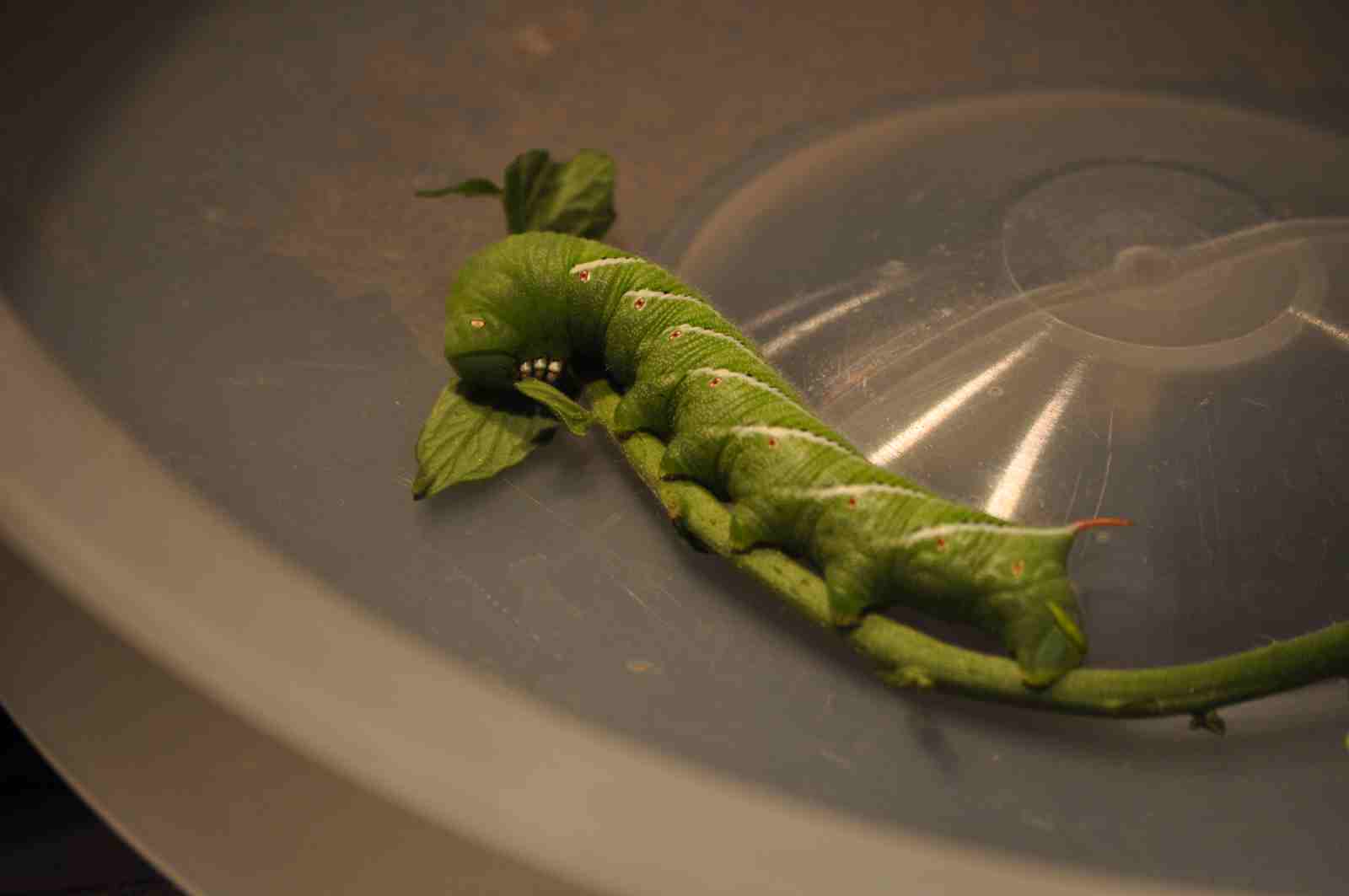
Bean beetles attacked the edamame tho' they didn't get most of the crop. The most interesting pests this year, however, were these guys:
 Longtime gardeners may recognize these as tobacco hornworms. If they weren't so devastating in how quickly they can strip a plant of its leaves, they'd be worth keeping around for pure entertainment value. I found their markings quite beautiful--even their strangely geometric poop (a bit like a bright green grenade) was interesting when fresh--until I saw how much of my already blight-stressed tomato plants they had eaten. The little buggers had even gnawed on a few tomatoes. Unforgiveable. These two were put out for birds to eat after I snapped a few more pix.
 Every other week since then, I've found one or two on the tomatoes. Death has been swift but messy. Too big to squish without squeamishness, I have opted for a quick snip with the kitchen shears. Then, this lady showed up:
 Well, I assume it's a she since it appears to be covered in eggs. I couldn't risk all those future tomato munchers being released into the world, so after their photo-op, everyone got dunked in the jar of alcohol normally reserved for ticks that hitch a ride on us or the dogs. (Note: I've just been informed that these were not hornworm eggs but rather the cocoons of a parasitic wasp. I should not have killed them--they're a beneficial. Next time I'll know to let the wasps develop so they can kill more hornworms).
Although this last pest has not really been an issue for us, I couldn't resist this perennial problem child when I saw it newly-emerged on Old Creaky:


Bean beetles attacked the edamame tho' they didn't get most of the crop. The most interesting pests this year, however, were these guys:


Although this last pest has not really been an issue for us, I couldn't resist this perennial problem child when I saw it newly-emerged on Old Creaky:

Pipped at the Post
I had better get some more posts up before Green Roof Gardeners steal all my good ideas.
I, too, had okra flowers to show off:
 Who knew Yankees would be growing okra? I should have taken pictures Tuesday while I made my first attempt at pickling okra. By the way, I had previously mentioned that I don't like okra. Turns out, if you cook it right, it's not bad. One simple preparation that worked well for me was just washing/drying the okra, slicing it into rounds which were then dredged in cornmeal, and frying them up in oil. Quick and tasty. Best of all: no slime factor.
And then there was going to be the extensive discussion of my worm bin:
 I do mine a bit differently. I bought a commercial version called a Worm Factory. It uses red wigglers and a series of bins that allow you to have several stages of compost at all times while providing compost tea via a spigot (truthfully, however, my spigot is almost always clogged so I just get the tea when I remove a layer).
In each layer I put a layer of food scraps (mostly veggies--no meat, dairy, fats, or garlic/onion). That's topped with a whole lot of shredded newspaper to give the worms a place to hang out when they're not eating. On top of that is a couple of layers of moist newspaper just to hold everything in. The worms move up and down eating and pooping. The layer on the bottom is harvested when all the food is digested and what remains looks like the richest soil you'll ever see. I keep putting new food in the top layer so the worms will move up.
Since worms don't like extremes of heat or cold, I keep the bin just inside our back door near the catbox. It doesn't smell (unless I accidentally put onion in there) or at least it's nothing compared to the catbox. And it's much faster at composting than my outdoor compost heap. I've had this bin system for about two years now and I've never had to buy more worms. I also make fewer trips out to the big compost heap, so it's more convenient. Best of all, I feel less guilty when food spoils before I get around to cooking it. Didn't get to that basil in time? Cilantro go slimy too fast? Not to worry. That's dinner for the worms.
I, too, had okra flowers to show off:

And then there was going to be the extensive discussion of my worm bin:

In each layer I put a layer of food scraps (mostly veggies--no meat, dairy, fats, or garlic/onion). That's topped with a whole lot of shredded newspaper to give the worms a place to hang out when they're not eating. On top of that is a couple of layers of moist newspaper just to hold everything in. The worms move up and down eating and pooping. The layer on the bottom is harvested when all the food is digested and what remains looks like the richest soil you'll ever see. I keep putting new food in the top layer so the worms will move up.
Since worms don't like extremes of heat or cold, I keep the bin just inside our back door near the catbox. It doesn't smell (unless I accidentally put onion in there) or at least it's nothing compared to the catbox. And it's much faster at composting than my outdoor compost heap. I've had this bin system for about two years now and I've never had to buy more worms. I also make fewer trips out to the big compost heap, so it's more convenient. Best of all, I feel less guilty when food spoils before I get around to cooking it. Didn't get to that basil in time? Cilantro go slimy too fast? Not to worry. That's dinner for the worms.
From Overdue to Overdone
Thanks to a combination of guilt and inspiration, I feel a whole lot of blog posts coming on. Bear with me as I catch up on some odds and sods.
Here's some wildlife that didn't make it into the last post:
 Can you see the little two-toned furry critter with the prehensile tail? Click on the pic to enlarge. Yes, it's the cutest 'possum I've seen yet. It's unusual both in that it put in an appearance in daylight and that it's not roadkill. I wish I could say it was just good luck, but after watching it with binoculars, I realized that it had been wounded--no doubt by our great hunter dog, Bru. One of the poor opossum's hind legs was bloodied and it was not walking too well on it. Still, it managed to get out of our yard and head back to the relative safety of the overgrowth around the fish pond. I'm guessing it survived the attack by, um, playing 'possum. Bru gives up on any critter once it stops moving (except box turtles--he always wants to get the prize inside the box).
Here's some wildlife that didn't make it into the last post:

Tuesday, July 27, 2010
Wildlife
We tend to think of Spring as the time for wildlife babies, yet now is the season when we really start to see them. I had thought I'd save this post until the cardinal eggs in the Rose of Sharon bush next to our back door hatched but, sadly, they aren't going to emerge. Mama cardinal sat on those eggs for weeks in the extreme heat and the pouring rain. I fear the eggs may have cooked despite her elaborate efforts to provide shade and air conditioning. They should have hatched by the two-week mark. She hung on for at least three weeks, then disappeared. Three speckled eggs remain in the nest. Now, I'll never know if one or more of the eggs which varied slightly in color were cowbird eggs snuck in there when she wasn't on the nest.

The deer, of course, have fared better. I've seen two fawns--one complete with Bambi spots--and heard many alarm noises from the does across the creek as they warned of impending danger (usually me walking down to the garden).
Rabbits abound and I seem to have made friends with one particularly handsome bunny. Well, maybe friends is too strong a term, but the muscular little guy doesn't seem nearly so jumpy as the others when I cross its path going back and forth to see the buffs.
Several of the wild turkey eggs survived the ravages of raccoon raids and now we have two female wild turkeys who have teamed up to make the rounds with their little ones. One set of three babies has just learned how to fly (and are much more graceful at it than are the adults) and the other set is still strictly terrestrial.
This week brought a new animal to our attention. While we haven't seen any babies yet, we did see an adult female eastern spiny softshell turtle in the creek. When a shiny rock in the creek kept disappearing and reappearing despite no change in the water level, I got the binoculars out and got a great reward: a view of a type of turtle I'd never seen before. It has a very flat and spotted shell--noticeably different from most of the turtles we see around here (e.g., box, snapping, and sliders)--and a snout that narrows dramatically at the tip. Apparently, this turtle is found in many states, but the river basin of the French Broad (of which our creek is a part) is the only place in NC where they are found. From what I've read they are quite shy but do have powerful jaws and claws which they are not shy about employing if you try to catch one. I'm quite happy to observe from the window seat and watch her bask in the sun on the sandy creek bank.
An indigo bunting sighting along the driveway added a bit of color to this week's wildlife. More to come, I'm sure, but another thunderstorm is approaching, so it's probably time to shut down the computer before it's shut down for me.

The deer, of course, have fared better. I've seen two fawns--one complete with Bambi spots--and heard many alarm noises from the does across the creek as they warned of impending danger (usually me walking down to the garden).
Rabbits abound and I seem to have made friends with one particularly handsome bunny. Well, maybe friends is too strong a term, but the muscular little guy doesn't seem nearly so jumpy as the others when I cross its path going back and forth to see the buffs.
Several of the wild turkey eggs survived the ravages of raccoon raids and now we have two female wild turkeys who have teamed up to make the rounds with their little ones. One set of three babies has just learned how to fly (and are much more graceful at it than are the adults) and the other set is still strictly terrestrial.
This week brought a new animal to our attention. While we haven't seen any babies yet, we did see an adult female eastern spiny softshell turtle in the creek. When a shiny rock in the creek kept disappearing and reappearing despite no change in the water level, I got the binoculars out and got a great reward: a view of a type of turtle I'd never seen before. It has a very flat and spotted shell--noticeably different from most of the turtles we see around here (e.g., box, snapping, and sliders)--and a snout that narrows dramatically at the tip. Apparently, this turtle is found in many states, but the river basin of the French Broad (of which our creek is a part) is the only place in NC where they are found. From what I've read they are quite shy but do have powerful jaws and claws which they are not shy about employing if you try to catch one. I'm quite happy to observe from the window seat and watch her bask in the sun on the sandy creek bank.
An indigo bunting sighting along the driveway added a bit of color to this week's wildlife. More to come, I'm sure, but another thunderstorm is approaching, so it's probably time to shut down the computer before it's shut down for me.
Sunday, July 18, 2010
National Ice Cream Day
Happy National Ice Cream Day, everyone! In honor of this momentous, albeit manufactured holiday, it's time to talk about my new favorite toy: an ice cream maker. Big thanks to my friend, Kristin, over at The Unfussy Epicure for turning me on to this amazing little device. Until she posted about her experience making very strawberry frozen yogurt with her Cuisinart ice cream maker, I had no idea that ice cream maker technology had advanced so far.
The home ice cream makers that I knew always seemed destined for the next garage sale due to the amount of effort required (e.g., ice, rock salt, churning) to make the delicious end product and the difficulty finding a place to store the bulky machine. This Cuisinart, which I found on sale at Amazon for $40, gets around all those problems. It's small, making a maximum of 1.5 quarts at a time, which is more than enough for me and takes the sting out of flavor experiments gone awry. Plus, it doesn't take up much counter space and is easy to stash in a cupboard, if need be. But I haven't stopped using mine long enough to bother putting it away. No rock salt required nor any ice--just enough room in the freezer to store the bowl until it's time to make ice cream. Since it's electric, the machine does all the churning work and it takes less than half an hour.
So far, I've made lemon sorbet, very strawberry frozen yogurt, nibby chocolate/sour cream frozen yogurt, and two batches of licorice ice cream.

All have turned out better than I could have possibly hoped for. I rarely get excited about kitchen appliances, but this one is truly worth every penny.
Now that I've recreated one of my two all-time favorite Baskin--Robbins flavors by making licorice ice cream, I need to figure out how to make Daiquiri Ice (the original, blue ice--not the lame, lime version). Then it's on to new adventures like cardamom ice cream. What flavors would you make, dear readers, if you could make your own ice cream/sorbet/fro yo?
The home ice cream makers that I knew always seemed destined for the next garage sale due to the amount of effort required (e.g., ice, rock salt, churning) to make the delicious end product and the difficulty finding a place to store the bulky machine. This Cuisinart, which I found on sale at Amazon for $40, gets around all those problems. It's small, making a maximum of 1.5 quarts at a time, which is more than enough for me and takes the sting out of flavor experiments gone awry. Plus, it doesn't take up much counter space and is easy to stash in a cupboard, if need be. But I haven't stopped using mine long enough to bother putting it away. No rock salt required nor any ice--just enough room in the freezer to store the bowl until it's time to make ice cream. Since it's electric, the machine does all the churning work and it takes less than half an hour.
So far, I've made lemon sorbet, very strawberry frozen yogurt, nibby chocolate/sour cream frozen yogurt, and two batches of licorice ice cream.

All have turned out better than I could have possibly hoped for. I rarely get excited about kitchen appliances, but this one is truly worth every penny.
Now that I've recreated one of my two all-time favorite Baskin--Robbins flavors by making licorice ice cream, I need to figure out how to make Daiquiri Ice (the original, blue ice--not the lame, lime version). Then it's on to new adventures like cardamom ice cream. What flavors would you make, dear readers, if you could make your own ice cream/sorbet/fro yo?
Tuesday, July 13, 2010
Watermelon Pickle
Nothing like hot, steamy weather to put one in a watermelon frame of mind. Normally, I'm opposed to the so-called seedless varieties both for the lie (there are seeds) and for taking the fun of seed spitting out of the equation. I did make an exception this time, as it was a freebie from EarthFare.
 Being the only watermelon eater in the household, I had to eat an heroic amount of this most hydrating of fruits in short order to get it to fit into the fridge. Then it was a race to finish before it went off. I saved the rinds to make watermelon pickle--a trick taught to me by my 3rd grade teacher, Mrs. Spencer. With a little help from a friend, rinds were peeled and diced, then boiled in a sugar, vinegar, and spice mixture until tender.

Water-bath canning ensued and voila! Sweet and tangy watermelon pickle.


Water-bath canning ensued and voila! Sweet and tangy watermelon pickle.

So, so tasty.

Subscribe to:
Posts (Atom)


